YachtFlags.com provides high quality courtesy flags that are manufactured in durable Knitted Polyester fabric. Knitted so that the fabric itself does not deteriorate in the constant movement that marine flags are usually exposed to, and polyester so that the flag does not weaken in the strong UV-light usually found in the main sailing areas of the world.
YachtFlags.com offers a discount to Noonsite members.
Use the coupon code NOONSITE-5A2B when checking out to get 10% off today.
YachtFlags.com provides high quality courtesy flags that are manufactured in durable Knitted Polyester fabric. Knitted so that the fabric itself does not deteriorate in the constant movement that marine flags are usually exposed to, and polyester so that the flag does not weaken in the strong UV-light usually found in the main sailing areas of the world.
YachtFlags.com offers a discount to Noonsite members.
Use the coupon code NOONSITE-5A2B when checking out to get 10% off today.
YachtFlags.com provides high quality courtesy flags that are manufactured in durable Knitted Polyester fabric. Knitted so that the fabric itself does not deteriorate in the constant movement that marine flags are usually exposed to, and polyester so that the flag does not weaken in the strong UV-light usually found in the main sailing areas of the world.
YachtFlags.com offers a discount to Noonsite members.
Use the coupon code NOONSITE-5A2B when checking out to get 10% off today.
The situation in Haiti is unstable, with gang violence paralysing the country. Supplies of fuel, food and water are very limited and cholera is rife. Cruising there should not be attempted at this time. The information below refers to times when cruising to Haiti was possible.
Haiti, which makes up the western third of the island of Hispaniola, is a passage through the “old Caribbean”. Its innocence is still present, but – like Cuba – is losing some of this old charm as it catches up to the modern world.
Haiti became the world's first black-led republic in 1804, after Gen Toussaint Louverture led enslaved people in an uprising. This incensed its colonial master France, which derived a large chunk of its income from Haiti's plantations, and it responded by forcing Haiti to pay inflated reparations to enslavers over 122 years. The US occupied Haiti from 1915 to 1934, sending in marines and military administrators. Further US military interventions occurred in 1994 and 2004, to "defend democracy" and restore order.
Poverty exists in Haiti. Frequent earthquakes have exacerbated it, the most recent being on August 14, 2021 in the SW of Haiti (Les Cayes near Ile a Vache being the worst affected) . In the larger cities, there are still areas of slums similar to the favelas in Rio de Janeiro. This country has the lowest per capita income in the Western Hemisphere: $400 in the cities, $100 in the rural areas.
Haiti has a UNESCO World Heritage site near Cap Haitian. The Citadelle Laferriere and the surrounding historical area is a highlight of the Caribbean.
Haiti now has two SSCA hosts, one on Ile a Vache and one on Ile a Gonave, an island about 30 miles west of Port-au-Prince.
Haiti offers easy entry into the Caribbean for North American sailors through the Windward Passage and parts of Haiti are very accessible. Clearance procedures are usually fast and feel informal compared to elsewhere.
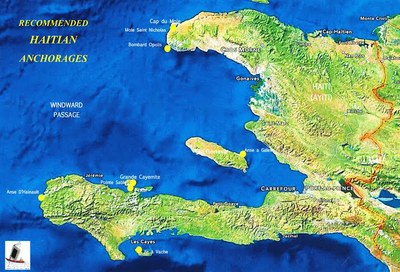
Those that use the Windward Passage can safely stop at Cap Mole St. Nicolas on the west side of the north peninsula or Bombardopolis on the southwest corner of the north peninsula.
Going south through the Windward Passage at the west end of the south peninsula is Anse d’Hainault and then just around the corner Ile a Vache.
Self-sufficiency is the key to visiting Haiti as there are no marinas or repair centres. It is good to have the ability to make drinking water as the potable water in Haiti is hard to come by and of poor quality.
The language of Haiti is Kreyol, however many speak French and some even speak English.
The capital, Port-au-Prince lies on the inside of the bay and is a bit of a long passage to reach it. Visit by land, not by sea: the primary wharf for the city is surrounded by one of the most densely populated slums in the West (Cite Soleil). However, just 35 miles to the west of the capital is the Bay of Bandareres, which is beautiful and not a dangerous area. See the Security section, however, for the latest situation.
The Island of Ile-a-Vache is safe and charming. They are well acquainted with cruising boats and it is as good a cruising destination as any in the Caribbean.
Cruising is best done from east to west as particularly during winter the strong trade winds make eastbound passages difficult. If going eastbound, cruisers normally do this along with the south coast as the north coast has more persistent swell from the Atlantic.
If visiting Haiti from Colombia, it is recommended to clear first at Jamaica at Port Antonio before proceeding east to Haiti.
A map of recommended anchorages in Haiti (yellow spot) by Frank Virgintino, author of the free Haiti Cruising Guide.
If you have information for this section, or feedback on businesses used, please let us know at editor@noonsite.com. We also welcome new information about businesses you have used (see Related Businesses).
As a free member or guest you are restricted to 3 formalities per month. You have viewed 0 formalities this month. Please login, register or upgrade your membership to view more.
Note: you can still view formalities you have already viewed this month without counting towards your monthly limit.