
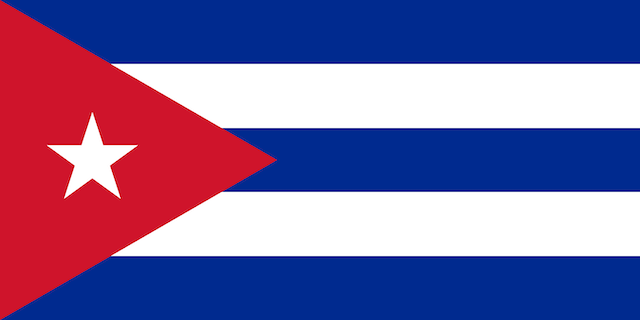
YachtFlags.com provides high quality courtesy flags that are manufactured in durable Knitted Polyester fabric. Knitted so that the fabric itself does not deteriorate in the constant movement that marine flags are usually exposed to, and polyester so that the flag does not weaken in the strong UV-light usually found in the main sailing areas of the world.
YachtFlags.com offers a discount to Noonsite members.
Use the coupon code NOONSITE-5A2B when checking out to get 10% off today.
YachtFlags.com provides high quality courtesy flags that are manufactured in durable Knitted Polyester fabric. Knitted so that the fabric itself does not deteriorate in the constant movement that marine flags are usually exposed to, and polyester so that the flag does not weaken in the strong UV-light usually found in the main sailing areas of the world.
YachtFlags.com offers a discount to Noonsite members.
Use the coupon code NOONSITE-5A2B when checking out to get 10% off today.
YachtFlags.com provides high quality courtesy flags that are manufactured in durable Knitted Polyester fabric. Knitted so that the fabric itself does not deteriorate in the constant movement that marine flags are usually exposed to, and polyester so that the flag does not weaken in the strong UV-light usually found in the main sailing areas of the world.
YachtFlags.com offers a discount to Noonsite members.
Use the coupon code NOONSITE-5A2B when checking out to get 10% off today.

PRE-ARRIVAL
To speed up Customs, Immigration and Health processing as the chosen port of entry, yacht crew can complete the online Advance Travel Form at https://www.dviajeros.mitrans.gob.cu/inicio. There is a button on the top right for English/Spanish. You will be emailed a QR code to show at Customs and Immigration when you enter.
It is recommended to reserve a berth in any of the northern Cuban marinas prior to arrival as yacht traffic to Cuba has increased greatly.
Ports of Entry:
Landfall must be at a designated port of entry. Under no circumstances should you arrive and anchor in a bay. Yachts may only clear in at a port of entry that also has a marina facility.
Be sure to contact your port of entry in advance to check they are open. Marina Gaviota Cabo de San Antonio, for example, have a tendancy to close when their generator is broken (no customs and no fuel).
The US still maintains a military base at Guantanamo Bay on the SE extremity of the island. This port should only be entered in an absolute emergency.
ARRIVAL FORMALITIES
Advance Notification:
As soon as Cuban territorial waters are entered 12 miles off the Cuban coast a yacht must contact the port authorities or coastguard (Guarda Frontera) on VHF Channel 16 or 77 or HF (SSB) 2128KHz. As most officials use hand-held radios, you may not be able to do this until closer inshore.
Various authorities also operate on the following:
Don't worry if you don't get an answer. If you have AIS on board it is likely the authorities will already be tracking you and will try to contact you via VHF and organize for officials to be there for your arrival.
In most ports, the harbormaster will answer in English. The following details should be communicated: name of the yacht, flag, port of registry, last port of call, intended port of arrival in Cuba with approximate ETA, type of yacht and number of people on board. The captain will then be given instructions to proceed.
Channel 16 is also monitored by the marinas, however, getting hold of someone at a marina can be difficult.
General Process:
On arrival in Cuba, yachts must go to the nearest Port of Entry, with the Q and courtesy flags flying.
The main port of entry for yachts is Hemingway Marina immediately to the west of Havana. All ports with marinas have tourist facilities and are used to clearing in yachts. The commercial port of Havana should not be entered as it has no provision for clearing yachts.
Once moored in port, wait for the officials to arrive and no one must go ashore until clearance is completed. You may be asked to anchor out for clearance. How many officials come on board will depend on the port, anywhere between 2 and 12 and possibly a sniffer dog as well.
See Documents for the paperwork required for clearing-in.
Note: An exit zarpe from your last port is not necessarily required. Neither the USA or The Bahamas normally issue one.
Clearance must first be obtained from Quarantine health officials, after which are the visits by Immigration, Customs, Agriculture Department officials and Guarda Frontera (Coast Guard). These officials are based in the marina and clearance is usually completed promptly (2-3 hours), unless you have firearms aboard.
Customs will wrap up any satellite communciations and/or drone with tape, so that they can't be used while in Cuba. They will want to know if you have bicycles/canoes/paddle board etc. on board and how many.
Officials are usually good-natured and whilst there is substantial paperwork to complete it all adds up to the excitement of visiting this country, which for so long has been off limits. Sometimes a small gift (such as coke or pen) or a tip is requested. You are not obliged to tip, and in many ports, a handout is frowned upon by the ranking official.
Domestic Cruising:
Once initial clearance is completed, a coastwise cruising permit (despacho de navegacion - Costera) can be obtained from the Coast Guard (Guarda Frontera) on departure. Be sure to advise the harbor master that you intend to cruise Cuba so the Guarda can be prepared. You must submit a cruising itinerary which has to be approved and the Coast Guard will keep track of you.
This permit currently allows you to cruise the waters of Cuba, it does not allow you to go ashore, except at a designated marina.
When cruising along the coast, one must report to the Guarda Frontera office in every port. However, nearly everywhere you stop an official will row out to you, will ask for your details and be very pleased if you produce a Spanish version of the answers he requires as he can then fill in his forms ashore. The official will let you know if you are permitted to go ashore or not. He will want to know your time of departure, will take your despacho away and, whatever time, will return it to you before you sail. All papers are usually inspected.
Officially yachts may only visit harbors and anchorages where there are marinas - except for the offshore cays. No other anchorage or harbor may be visited and if it is, the captain and crew may not go ashore.
CLEARING OUT
Twenty-four hours' notice of departure should be given, if possible, even if sailing to another port in Cuba.
Before departure, one must clear out with the Guarda Frontera at an official port of entry/exit. They will retain the despacho and issue a new exit despacho (clearance certificate) along with the cruising permit. One must also clear out with customs and immigration.
USA SPECIFIC FORMALITIES
Under current US law private American flagged vessels cannot legally enter Cuba unless they have an export permit issued issued by the US Dept of Commerce and a Permission to Enter the Territorial Waters of Cuba (CG3300) issued by the USCG. These permits are extremely difficult to obtain. See Restrictions for details.
That said, the Cubans give a warm welcome to American yachts.
Note: American citizens sailing to Cuba on other flagged vessels will not have a problem entering the country.
Last updated: May 2024
If you have information for this section, or feedback on businesses used, please let us know at editor@noonsite.com. We also welcome new information about businesses you have used (see Related Businesses).

As a free member or guest you are restricted to 3 formalities per month. You have viewed 0 formalities this month. Please login, register or upgrade your membership to view more.
Note: you can still view formalities you have already viewed this month without counting towards your monthly limit.